Hello there! You've reached the portfolio-ish site of Ben Leduc-Mills. This website captures some of my career from user research and service design, to interaction design, software engineering, rapid prototyping & digital fabrication, open source hardware, and of course, AI.
The Future of AI-Driven Code Review

A competitive and market analysis of the fast-emerging AI code review space, with strategic recommendations for where GitLab could move next. Done in Q1FY27, so by the time you read this it’s undoubtedly out of date — but it wasn’t at the time.
Context & Contributions
Code review is one of GitLab’s core strengths, but a new, well-funded category of dedicated AI code review tools had emerged in the space of about 18 months, and none of them were GitLab. I wanted to understand who these competitors actually were, what they were building, and what it meant for GitLab’s own AI code review strategy, then turn that into something leadership and product and engineering teams could actually act on.
I researched, wrote, and produced this report solo.
PROJECT DETAILS

ROLE: SOLE RESEARCHER & AUTHOR
PROJECT TYPE: COMPETITIVE / MARKET ANALYSIS
DURATION: ~ 2 weeks
Problem
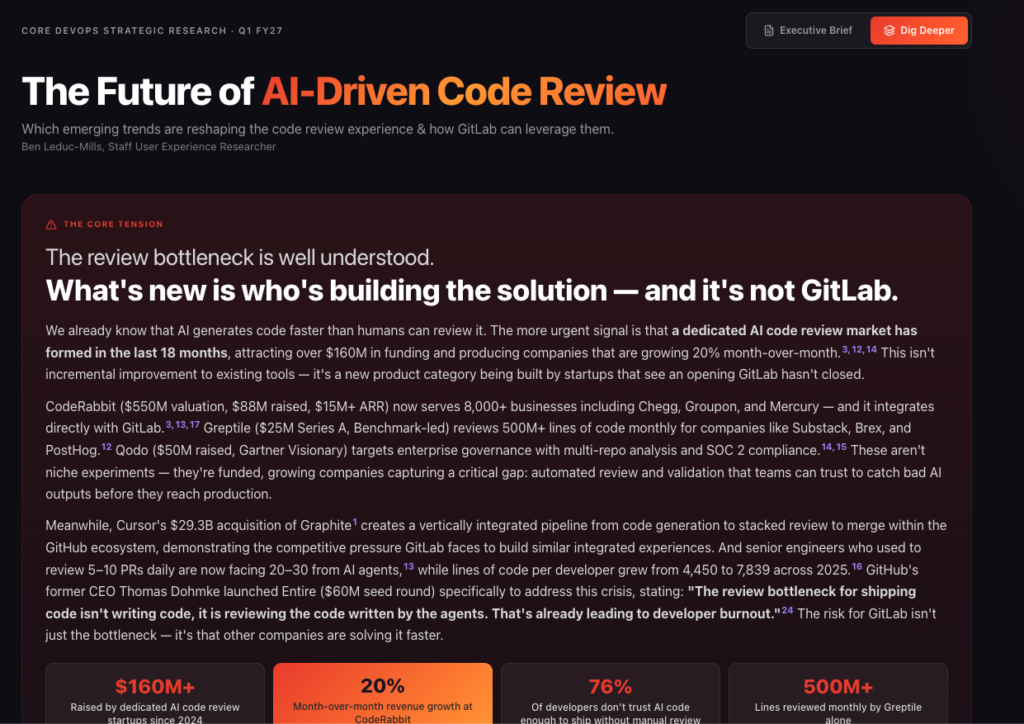
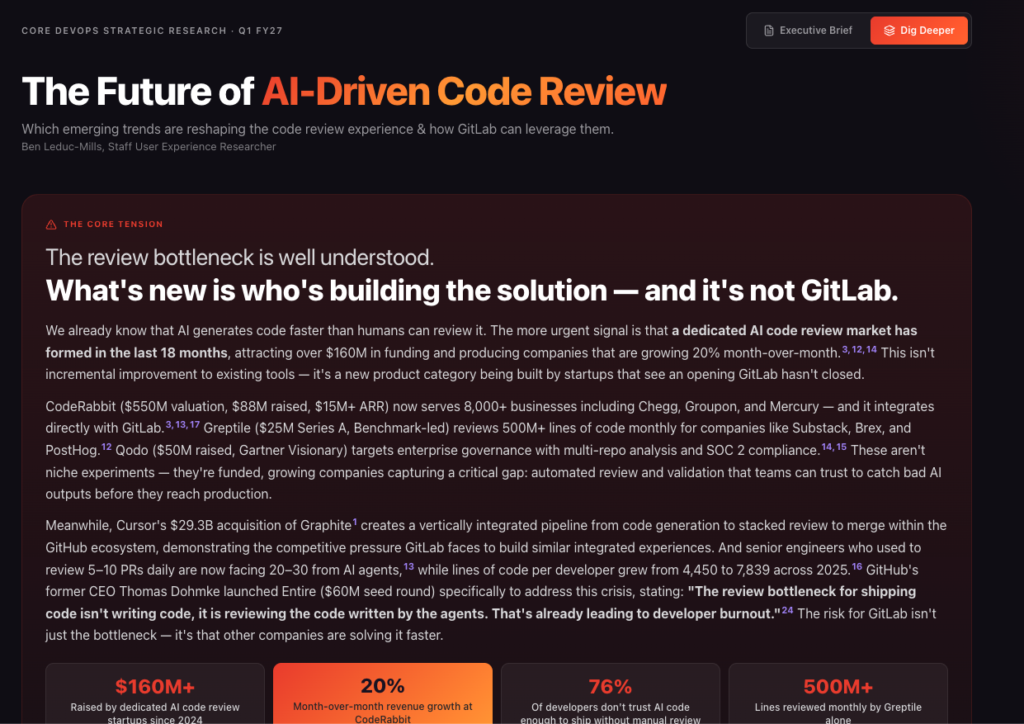
AI is generating code faster than humans can review it, and a dedicated AI code review market had formed around that gap: startups raising real money, growing fast, and in some cases integrating directly with GitLab rather than competing head-on. That’s not a niche experiment, it’s a new product category, and I wanted to know whether GitLab was positioned to compete in it or at risk of watching it get built around us.
Hypothesis
I suspected that GitLab’s platform-level view, spanning planning through deployment, was a real, underused advantage in this space, one that no point-solution competitor could easily replicate, but only if GitLab moved deliberately to claim it before a competitor became the default governance layer for AI-generated code.
Methods & Process
Understanding
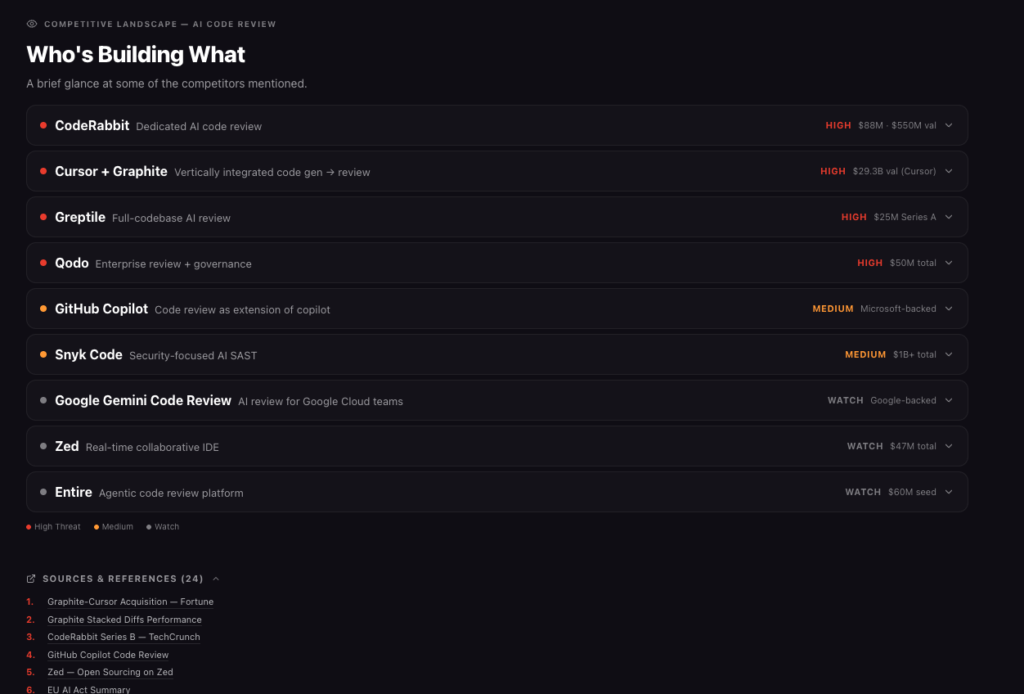
I pulled together desk research on the competitive landscape: funding, valuations, growth rates, and product positioning for the main players. Four companies led the analysis: CodeRabbit ($550M valuation), Greptile ($180M valuation, Benchmark-backed), Qodo (Gartner Visionary status, enterprise governance focus), and Graphite, now folded into Cursor’s $29B acquisition. I tracked a second tier as ones to watch, including GitHub Copilot, Snyk Code, Zed, and Entire, GitHub’s former CEO’s new venture built specifically around the agentic review bottleneck. I backed this with 24 external sources: industry reporting, funding announcements, and public statements from competitor leadership. Alongside that, I went back through GitLab’s own research library and internal usage data to ground the analysis in what we actually knew about our own users, not just what competitors were claiming about theirs.
Refining
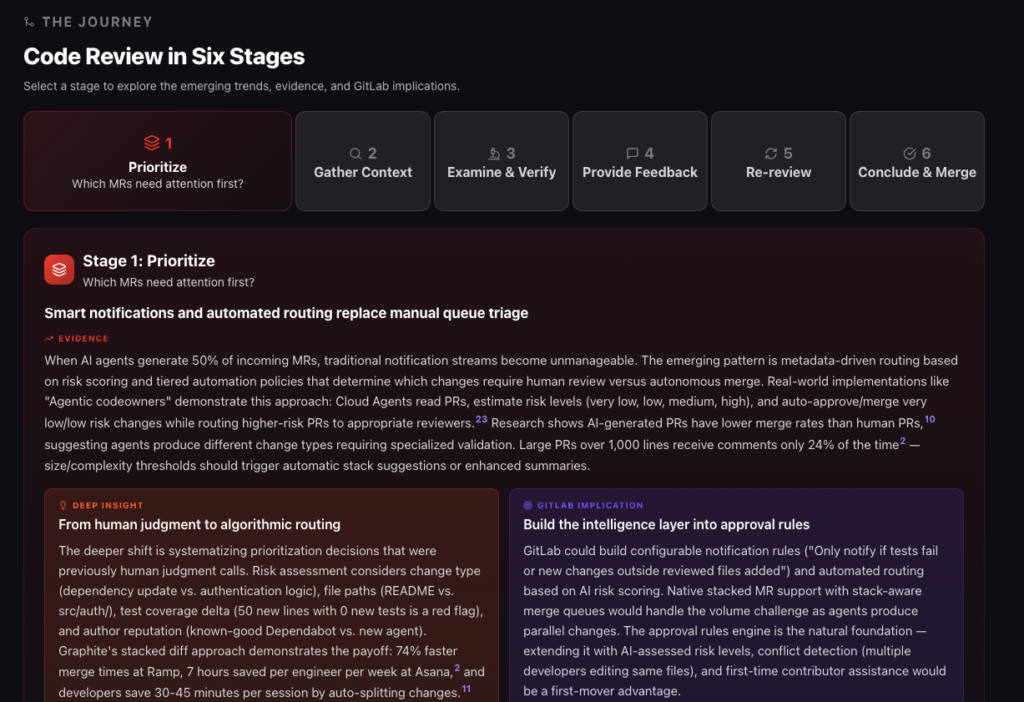
I talked informally with PMs, engineers, and designers across GitLab as I went, showing them early drafts and getting their read on where the analysis held up and where it didn’t. That feedback loop shaped the report as much as the external research did. I organized the findings around the six stages of the code review workflow itself: Prioritize, Gather Context, Examine & Verify, Provide Feedback, Re-review, and Conclude & Merge. For each stage I laid out the emerging trend, the evidence behind it, a deeper insight into what’s really shifting, and a specific implication for GitLab.
Delivering
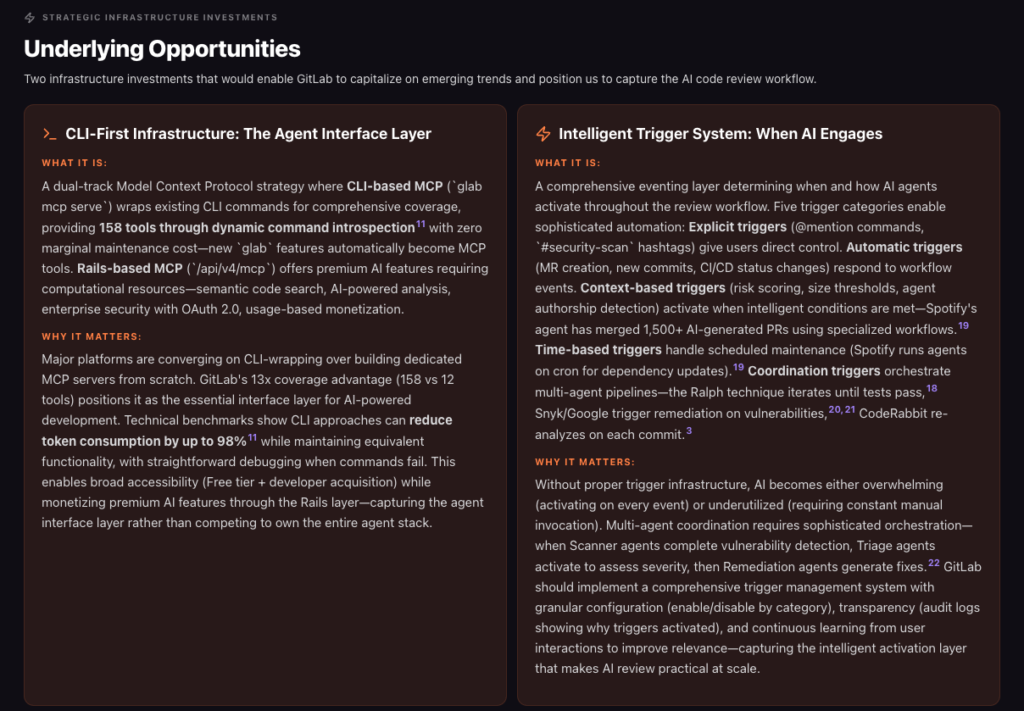
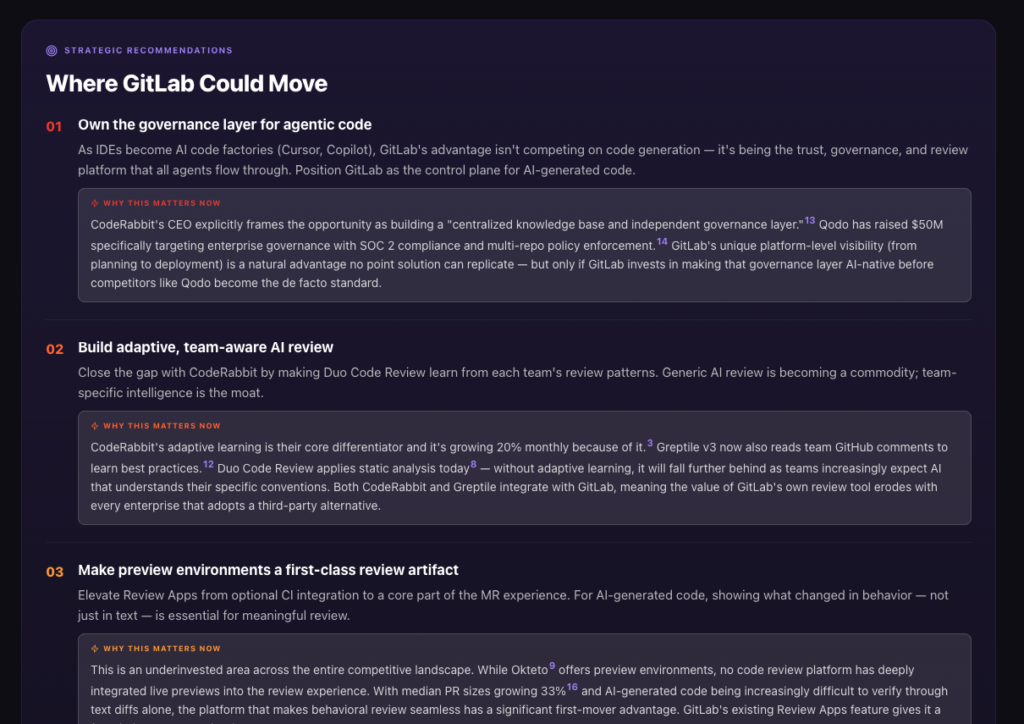
From there I pulled out two underlying infrastructure investments that cut across the whole workflow: a CLI-first approach to how AI agents interface with GitLab, and an intelligent trigger system to determine when and how AI should activate throughout the review process. I closed with three concrete strategic recommendations: own the governance layer for agentic code, build adaptive team-aware AI review rather than generic pattern matching, and make preview environments a first-class part of the review experience, not just a CI add-on. Each recommendation came with a “why this matters now” section grounding it in a specific competitive move already happening in the market.
Findings & Results
The market data alone made the case for urgency: over $160M raised by dedicated AI code review startups since 2024, one competitor growing 20% month-over-month, and senior engineers going from reviewing 5-10 PRs a day to 20-30 as AI agents generate more of the incoming work. 76% of developers don’t yet trust AI code enough to ship it without manual review, which is exactly the gap GitLab’s platform position is suited to close, if we move on it.
The report’s core argument was that this is a narrow window: startups are already capturing enterprise customers with solutions that integrate directly with GitLab rather than replace it, and GitLab has a real chance to make AI code review a reason companies choose GitLab instead of a gap they patch with a third-party tool. That window won’t stay open indefinitely.
Many of the findings and recommendations from this report have since been incorporated into GitLab’s future vision work for our next-generation product.